Skills belong to you, not to a titan. You build one loadout and every titan you field carries it.
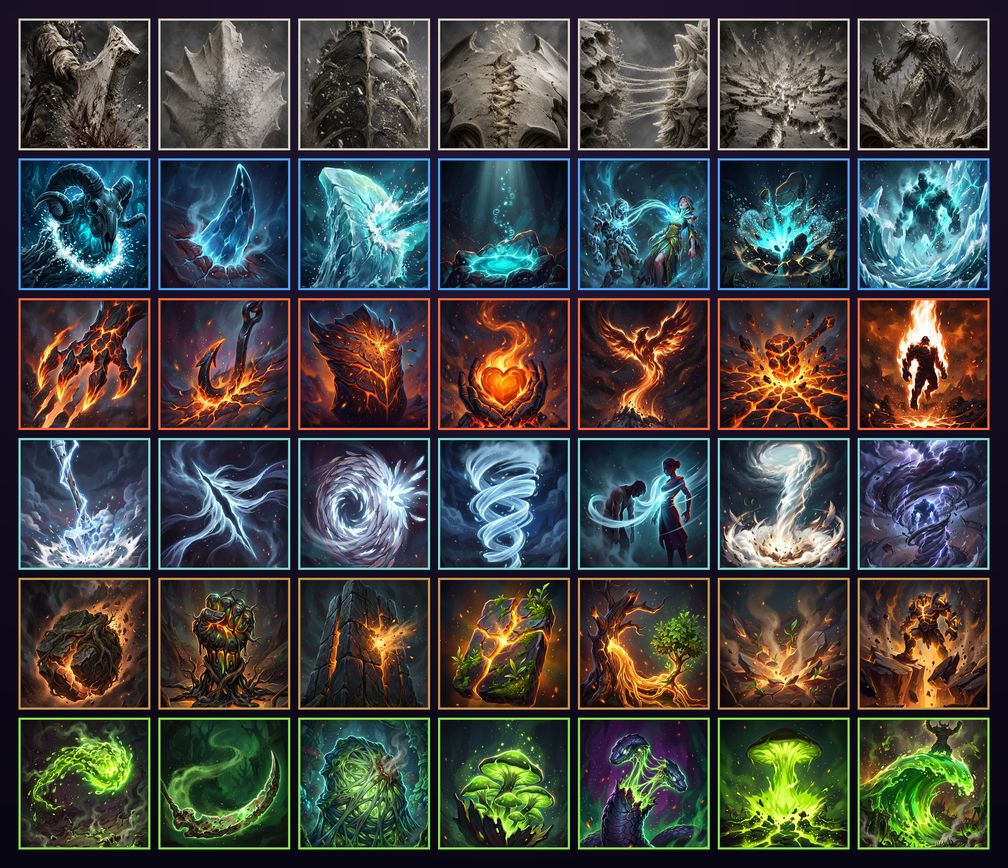
Four slots
One attack skill, one defence skill, one support skill and one ultimate. The slots are role-locked — you cannot carry three attack skills. They open as your equipped titan levels: the attack slot early, then defence, then support and the ultimate together. A titan below the first gate carries no skills at all, which is why your first few raids are pure board play.
The ultimate pool has a second gate: no ultimate blueprints drop until your Citadel is far enough along.
The seven families
- Strike (attack) — one big hit, blunted by the defender's armour like any other.
- Venom (attack) — poison. Pays out every turn for three turns, so it out-totals Strike but takes its time. Bad on a fight that is nearly over.
- Guard (defence) — raises a shield off your armour, and breaks a seal.
- Mend (support) — a flat heal off your maximum health.
- Leech (support) — lifesteal for a couple of turns, up to a cap.
- Crush (support) — every tile you break hits harder for a couple of turns, up to a cap.
- Berserk (ultimate) — adds a chunk of your attack to the board for two turns, plus your element's rider.
Mana, and the seal
Mana fills only by clearing tiles — there is no per-turn trickle. An attack skill costs the most of the three, a support skill the least, and the ultimate costs the entire bar. Casting never costs you a turn, so mana is the only thing rationing you: a cast is always free in tempo, and the question is only whether you can afford it.
The enemy can seal one of your cards for two turns. Casting your defence skill breaks the seal — which is a reason to hold it rather than spend it early.
Element is identity, not power
Every elemental version of a family hits for exactly the same. What matching buys you is the set bonus: equip skills whose element matches your titan's and your skill output rises, more for each slot that matches. So a coherent, single-element loadout beats a scattered one made of individually nicer cards.
Today the seven natural skills are the claimable ones — Bone Cleaver, Rot Bite, Chitin Wall, Sinew Knit, Marrow Draw, Shatterbone and the Feral Surge ultimate. They are deliberately a little weaker than an elemental version and can never earn the set bonus. The 35 elemental variants are reserved for events and quests and show as SOON; when one arrives, the natural you have been levelling still works.
Getting and raising skills
Any skill or ultimate unlocks with blueprints, and it is the same number whatever the skill is. Blueprints come from boxes, and while the elementals are reserved every skill blueprint you find lands on a natural. Skills then level to 100 on coins plus their own DNA, exactly like a titan, and every skill level pays rank stars at the same rate a titan level does.
Your loadout is also what defends you: the four skills and their levels are published with your base, so a raider fights your real kit while you are away. A loadout you never finish is a defence you never get.